
Sinovac & Sinopharm may offer better protection against severe COVID when combined with mRNA vaccines


FB screengrab: Lim Tean
A study conducted by the Duke-NUS Medical School has shown that inactivated virus vaccines such as Sinopharm and Sinovac may also work in preventing severe Covid.
This suggests that a combination of this type of vaccine with mRNA vaccines may work better than using only one type.
Sinovac and Sinopharm have been considered by some to not be as effective as mRNA vaccines since they induce a lower antibody response. However, the new study shows that Sinopharm and Sinovac trigger different T-cell responses in fighting Covid, The Straits Times reported on Monday (Nov 14).
With mRNA vaccines, a part of the coronavirus’ genetic code is injected into a person’s body. This activates the production of viral proteins, but not the whole virus, in order to train the immune system to attack.
On the other hand, Sinovac and Sinopharm, which are examples of inactivated vaccines, use dead viral particles in order to expose immune systems to the virus without the risk of serious disease.
mRNA vaccines, such as the ones from Pfizer and Moderna, induce T-cells, which target the coronavirus’ spike protein.
But inactivated vaccines cause a broader immune response against various proteins of the coronavirus.
Therefore, says Anthony Tanoto Tan, a senior research fellow with the Duke-NUS’ Emerging Infectious Diseases programme, vaccines such as Sinovac and Sinopharm may not be as effective in preventing infection, but they may be key in preventing serious diseases from developing. Dr Tan is the study’s senior co-author.
mRNA vaccines were shown to produce more antibodies compared to inactivated vaccines. But with new variants that successfully evade the antibody response, “This means that maybe we should stop thinking about preventing infection, and we should start thinking about (how) vaccines (can prevent) severe disease,” ST quotes Dr Tan as saying.
Reactions to the results of the study have been mixed.
One netizen wrote, “It was obvious before! Surprised that they re coming up with it only now!”
Newsletter
Get updates straight to your inbox
 Screenshot from Facebook comments /The Straits Times[/caption]
Another said they would wait “for MOH clarification.”
[caption id="attachment_459134" align="aligncenter" width="814"]
Screenshot from Facebook comments /The Straits Times[/caption]
Another said they would wait “for MOH clarification.”
[caption id="attachment_459134" align="aligncenter" width="814"] Screenshot from Facebook comments /The Straits Times[/caption]
Alarmingly, one commenter compared getting Covid to the flu, which some studies have debunked, showing that Covid-19 may reinfection carry higher risks of organ damage or even death.
[caption id="attachment_459135" align="aligncenter" width="811"]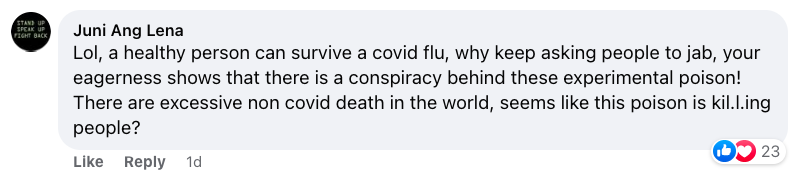 Screenshot from Facebook comments /The Straits Times[/caption]
Others, however, appeared to treat the results of the Duke-NUS Medical School study as good news.
[caption id="attachment_459136" align="aligncenter" width="825"] Screenshot from Facebook comments /The Straits Times[/caption]
/TISG
https://theindependent.sg/covid-19-reinfection-carries-higher-risks-of-organ-damage-or-even-death-regardless-of-vaccination-status/