
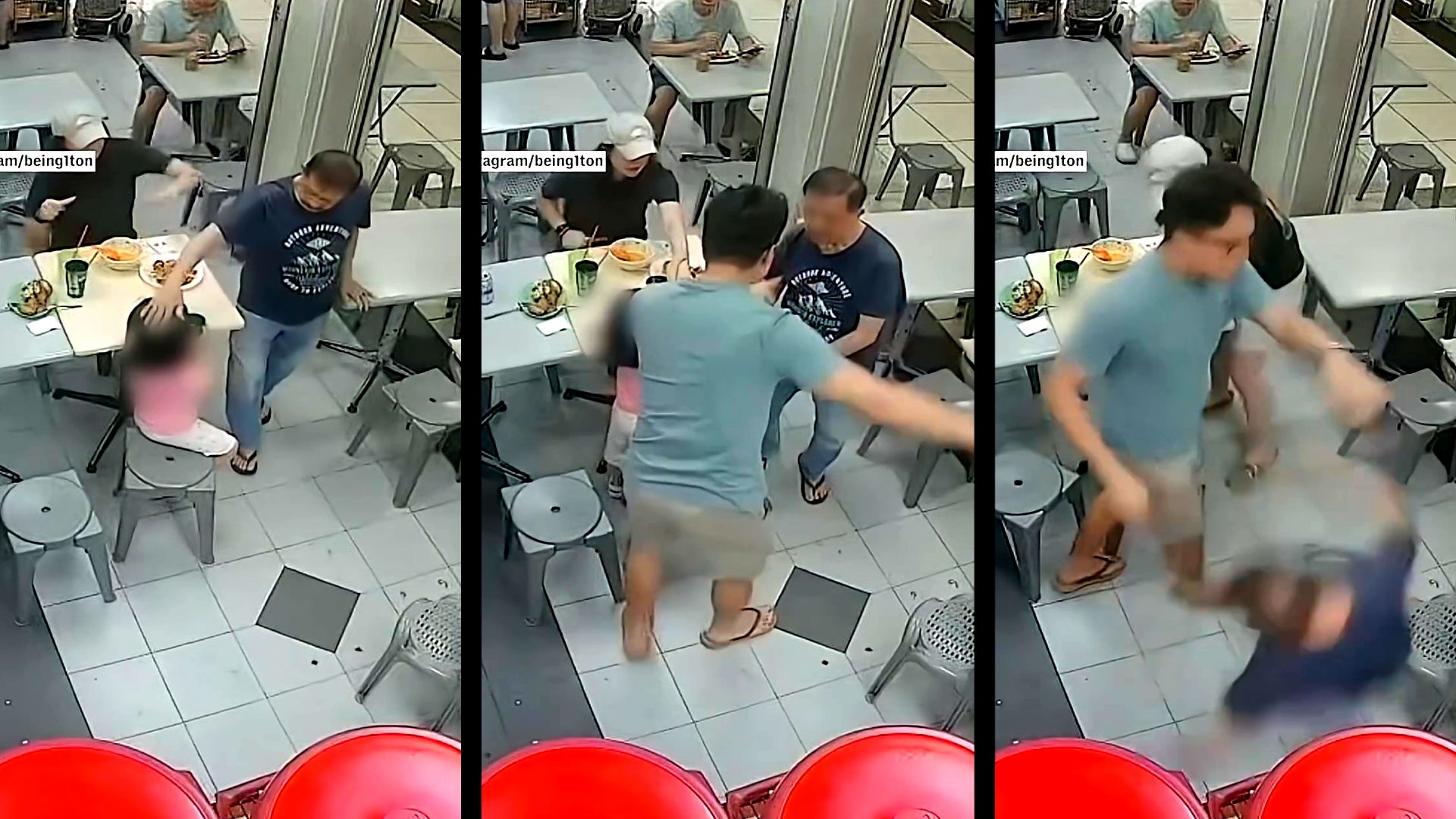
Man, 40, assaults 73 y/o man for patting his daughter's head in SG coffeeshop at East Coast Road
OPINION: A pat on child’s head doesn’t justify violence against elderly person; children need to protect their boundaries, but violence isn't the lesson to teach them
Summary
Police are investigating an Aug 15 incident in which a father is seen shoving a 73-year-old man after he patted the father’s young daughter.
The incident has ignited a fiery debate about personal boundaries, generational habits, parenting styles and changing social norms in Singapore.
Parents can teach children to speak up when they feel uncomfortable while showing them that boundaries can be defended without resorting to violence.
SINGAPORE: Police investigations are ongoing after a father allegedly shoved a 73-year-old man to the floor at Roxy Square on Aug 15. The older man had reportedly patted the father’s young daughter on the head.
Whatever one thinks about the pat, it doesn't justify violence against an elderly person, opined Charlene Tan, supervising editor at CNA Digital, as she looked beyond the clash and questioned the lessons children take from such moments.
Debates online have since taken several paths. Some see it as a clash between older and younger generations. Others blame changing parenting ideas or a society where people have become more wary of strangers, Channel NewsAsia (CNA) reports (Aug 22).
Children learn from how adults react
Personal boundaries aren't new. What has changed is how deliberately children are taught to understand and express them.
Children learn from an early age that they can speak up when something makes them uncomfortable. In primary school, lessons include recognising appropriate and inappropriate touch and finding a trusted adult when they feel unsafe.
Teaching children about such matters can protect them, especially when reports of child abuse appear in places where parents expect children to be safe. A child shouldn't have to accept unwanted contact simply because an adult meant well.
A pat on the head may feel harmless to one person and uncomfortable to another. Both reactions can exist without escalating into a verbal or physical fight, especially when we’re living in a modern and civilised society, if I may add.
A pat on the head means different things to older and younger people
Social habits change, but people don't all change at the same speed.
Someone who has always patted children on the head as a friendly gesture may not realise that some parents may see it differently. Although it doesn't make the gesture malicious, it also doesn't mean a parent must ignore their own boundary.
For this reason, calling the Roxy Square incident a generational clash misses something unseen. Older people can learn new social expectations. Younger parents can also explain their boundaries without assuming bad intentions.
The same applies within families. Parents may ask relatives not to pressure children into hugs or kisses. Children can be taught that refusing physical affection isn't rude. The purpose is to help children understand that they have a say over their own bodies.
Safer alternative gestures than a pat on the head
Teaching boundaries involves more than telling children what they should accept.
Children watch what adults do when something goes wrong. If parents respond calmly when a boundary is crossed, children see that discomfort can be handled without aggression.
It isn’t to say that parents must stay silent in such situations. A parent can step in, move the child away, and explain that the contact wasn't welcome. The other person doesn't have to agree with the boundary, but they can still oblige it.
Newsletter
Get updates straight to your inbox
There are also safer alternative gestures to unsolicited touching, such as a pat on the head. Adults can just smile, say hello, wave, or give a high-five, and let the child decide whether to respond. Such small changes give the child some control over the interaction.
Boundaries don’t need violence to be respected
Children must know that feeling uncomfortable is valid. They should also know what they can do next. They can say no, move away, seek help, or tell a trusted adult. Parents can model the same approach when they need to step in.
Protecting a child’s boundaries doesn’t require treating every stranger as a threat. It also doesn’t require accepting every unwanted gesture in silence.
A calm explanation can do something violence never can. It shows children that while their boundaries matter, respecting others’ boundaries matter too.
Read related: SPF: Police have identified man, 40, who assaulted 73 y/o man for patting child’s head in SG coffeeshop at East Coast Road