
National Wages Council: 6% to 8% pay raise recommended for lower-wage workers who earn up to S$2.8K/month in Singapore


Singapore recommends wage increases for lower-wage workers
Summary
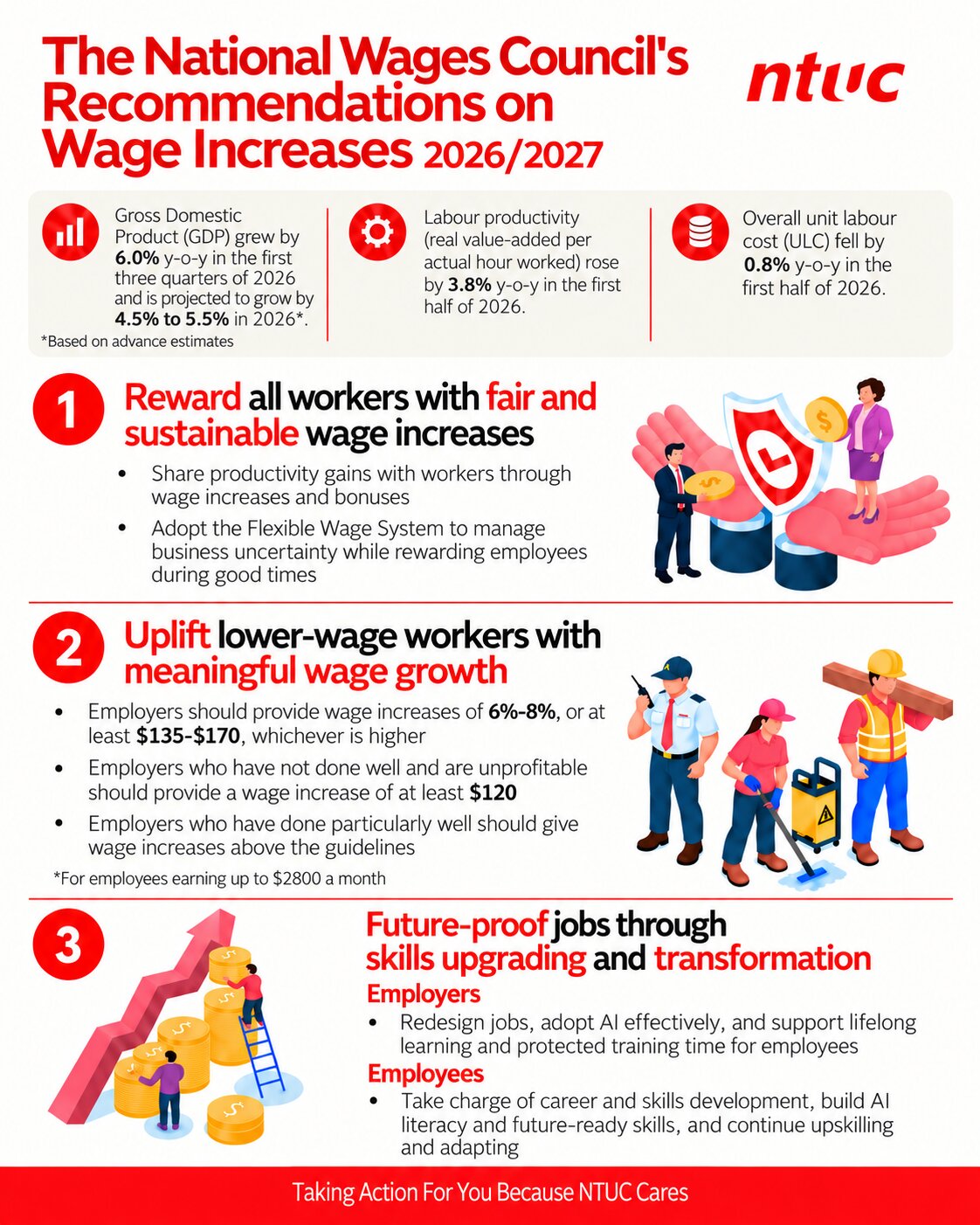
Singapore’s National Wages Council recommends built-in pay increases of 6% to 8% for lower-wage workers earning up to S$2,800 monthly.
Employers facing poor business results and losses are advised to provide eligible lower-wage workers with at least S$120 in built-in monthly wage increases.
NTUC urges firms to share economic gains fairly and give workers protected training time to prepare for changes driven by artificial intelligence.
SINGAPORE: Singapore’s lower-wage workers could receive higher pay under new National Wages Council (NWC) guidelines, with recommended built-in wage increases of 6% to 8%.
The guidelines for 2026/2027 cover workers earning gross monthly wages of up to S$2,800. The National Trades Union Congress (NTUC) welcomed the recommendations on Oct 19, calling for employers to share their business gains with workers.
The recommendations also account for firms facing financial difficulties, urging employers to make time for staff to learn new skills as artificial intelligence (AI) changes jobs.
Wage increases depend on business performance
Employers that perform well and have positive business prospects are advised to offer increases at the higher end of the range, or at least S$135 to S$170, whichever is higher.
Firms performing well but facing uncertain prospects should consider the middle of the range. Those that remain profitable despite poor performance should follow the lower of the two, or provide at least S$120, whichever is higher.
For businesses that have performed poorly and are incurring losses, the recommended amount is at least S$120.
The new category recognises that not every business benefits equally from economic growth. Singapore National Employers Federation President Kuah Boon Wee said some employers had struggled to afford wage increases recommended in previous years.
NTUC said the flexibility was intended to help struggling firms continue raising the pay of lower-wage workers. Employers must still meet existing Progressive Wage Model and Local Qualifying Salary requirements.
Economic growth should benefit workers
The recommendations come as Singapore’s economy recorded stronger-than-expected growth. Advance estimates showed economic growth of 6% year on year in the first three quarters of 2026, with full-year growth projected at 4.5% to 5.5%.
Labour productivity rose by 3.8% in the first half of 2026, while overall unit labour cost fell by 0.8%.
However, the gains have been uneven. Strong global demand linked to AI supported sectors such as electronics and precision engineering, while food and beverage services contracted.
NTUC President K. Thanaletchimi urged successful businesses to reward workers through higher fixed wages and variable payments. She also called for fair treatment of professionals, managers and executives.
The council’s guidelines are recommendations rather than mandatory rules. The Government has accepted them and will work with NTUC and the employers’ federation to encourage adoption.
The Progressive Wage Credit Scheme has also been extended until the end of 2028 to help eligible employers manage wage increases while investing in their businesses and workers.
Unions can help ensure fair wage decisions
NTUC wants employers to share relevant financial information with unions during wage negotiations. This would help workers understand how pay decisions are made and whether the recommendations are being applied fairly.
Newsletter
Get updates straight to your inbox
NTUC Assistant Secretary-General Melvin Yong said unions maintain regular contact with companies and have an ongoing understanding of their business performance.
Unionised firms tend to adopt the wage guidelines at higher rates, he added. Even when companies don't meet the full recommendations, unions can use them as a benchmark during annual negotiations.
NTUC is also urging employers to give workers protected time for training, rather than expecting them to learn new skills entirely outside working hours.
Its AI-Ready SG initiative supports businesses adopting AI and helps workers build relevant skills. Company Training Committees can help firms improve productivity, redesign jobs and train staff. Eligible projects can receive co-funding of up to 70% of qualifying costs through the CTC Grant.
NTUC members can also access up to S$500 in training support through the Union Training Assistance Programme for eligible courses and AI tools.
Higher wages do help, but workers also need the skills to keep pace with changing jobs. Employers should make fair pay and proper training part of the same plan, giving staff a real chance to benefit when their businesses succeed.