
Mexico's next president likely to defy Trump on immigration

6 m read
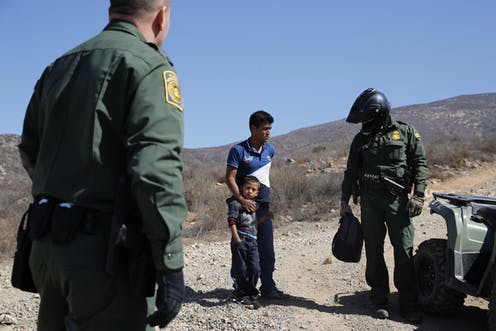
The Trump administration's new family separation policy has become a hot issue in Mexico's presidential election. All four candidates say that Mexico must do more to respect the human rights of Central American migrants. AP Photo/Jae C. Hong
Nobody’s piñata
Presidential front-runner Andrés Manuel López Obrador is an outspoken Trump critic who recently denounced separating migrant families as “arrogant, racist and inhuman.” He is widely expected to win on Sunday. The 64-year-old leftist has led the four-way race for months and currently has 49 percent of voter support, according to the latest polls. López Obrador launched his presidential bid on April 1 with a rally in Ciudad Juárez, the northern Mexico city where thousands of migrants cross into the U.S. each year. In a fiery speech, López Obrador promised that, with him as president, Mexico would reassert itself as a “free, sovereign and independent” nation and would not be the “piñata” of any foreign power. An early critic of President Peña Nieto’s Southern Border Program, López Obrador has accused the Mexican government of committing human rights violations in its persecution and deportations of Central American migrants. On his watch, Mexico would still “pay special attention” to its southern border, López Obrador says, but it would no longer do Trump’s “dirty work.” López Obrador wants Mexico to respect existing laws that protect the human rights of migrants and guarantee that asylum-seekers can find refuge in its borders. Ricardo Anaya, the right-of-center second-place candidate, has also attacked President Peña Nieto’s policy of detaining and deporting Central American migrants. Anaya says his country must be a “moral authority” on immigration, treating Central Americans in Mexico as justly and humanely as Mexican immigrants would like to be treated in the U.S.The changing face of migration
Illegal immigration to the U.S. has changed radically over the past two decades. The number of Mexicans apprehended crossing illegally has plummeted, from more than 1.6 million in 2000 to 130,000 last year. Central Americans, driven by endemic violence and pervasive poverty, now make up a bulk of all people caught trying to cross the U.S.-Mexico border. In 2017, U.S. Border Patrol agents there arrested 303,916 migrants. Just over half of them – 162,891 people – were from Guatemala, Honduras and El Salvador. Mexico has thus become a major transit country for migrants. It is also, increasingly, their final destination. Mexico saw 12,700 asylum requests from Central American refugees, up from 8,800 in 2016 and 3,400 in 2015. Only the U.S. received more Central American asylum-seekers, according to the United Nations Refugee Agency. Rather than welcome Central Americans, President Peña Nieto’s administration in 2014 accepted US$90 million of American funding to better secure its borders. His government has ruthlessly persecuted migrants who journey through the country. Mexico detained 40,920 Central American migrants between January and April 2018 alone. Nearly 35,000 were deported. In 2016, the Obama administration recognized Mexico for “absorbing” so many Central American migrants. Trump has expressed no such gratitude.The high cost of appeasing Trump
In 2016, Peña Nieto’s advisers invited both U.S. presidential candidates to visit Mexico. Clinton declined the invitation. Trump, whose 2016 campaign was fueled by promises to build a “big, fat, beautiful” border wall, accepted. In a joint press conference on Aug. 31, 2016, Peña Nieto emphasized his country’s contribution to U.S. immigration enforcement. The border, Peña Nieto said, represents a “shared challenge” and a “great humanitarian crisis.”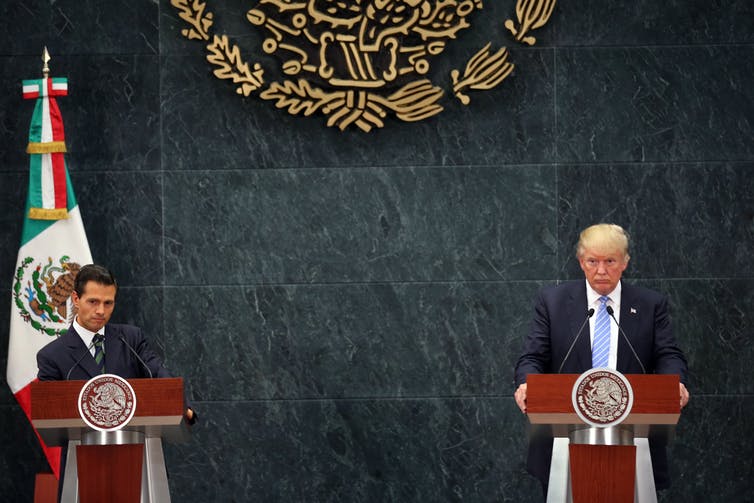 Trump’s August 2016 visit to Mexico was calamitous for President Enrique Peña Nieto. AP Photo/Dario Lopez-Mills[/caption]
Another Mexican revolution
López Obrador, a savvy career politician, has benefited from Peña Nieto’s mistake. Even the choice of location for his campaign launch, Ciudad Juárez, sent a powerful message that López Obrador’s attitude toward Trump would not be one of deference. Juárez is not just a border city – it’s a symbolic place in Mexican history. It was the bulwark where Mexico’s only indigenous president, Benito Juárez, in 1867 fought back a French invasion and re-established a sovereign Mexican government. Juárez was also home to key moments in the Mexican Revolution, which began in 1910. López Obrador closed his campaign on June 27, four days before the election as required by Mexican law. At a massive rally in Mexico City’s Azteca stadium, he promised 100,000 supporters that he would “transform” their country. Like so many of López Obrador’s lofty campaign commitments, his immigration plan is short on details. But it’s clear Trump has already lost his power of intimidation south of the border – even if, to paraphrase his own verbal jab, he doesn’t know it yet.Luis Gómez Romero does not work for, consult, own shares in or receive funding from any company or organization that would benefit from this article, and has disclosed no relevant affiliations beyond their academic appointment.
Newsletter
Get updates straight to your inbox
Source: US-Politics
Tags
trade war