
IN FULL: Deputy Prime Minister Heng Swee Keat's S$33b Fortitude Budget speech

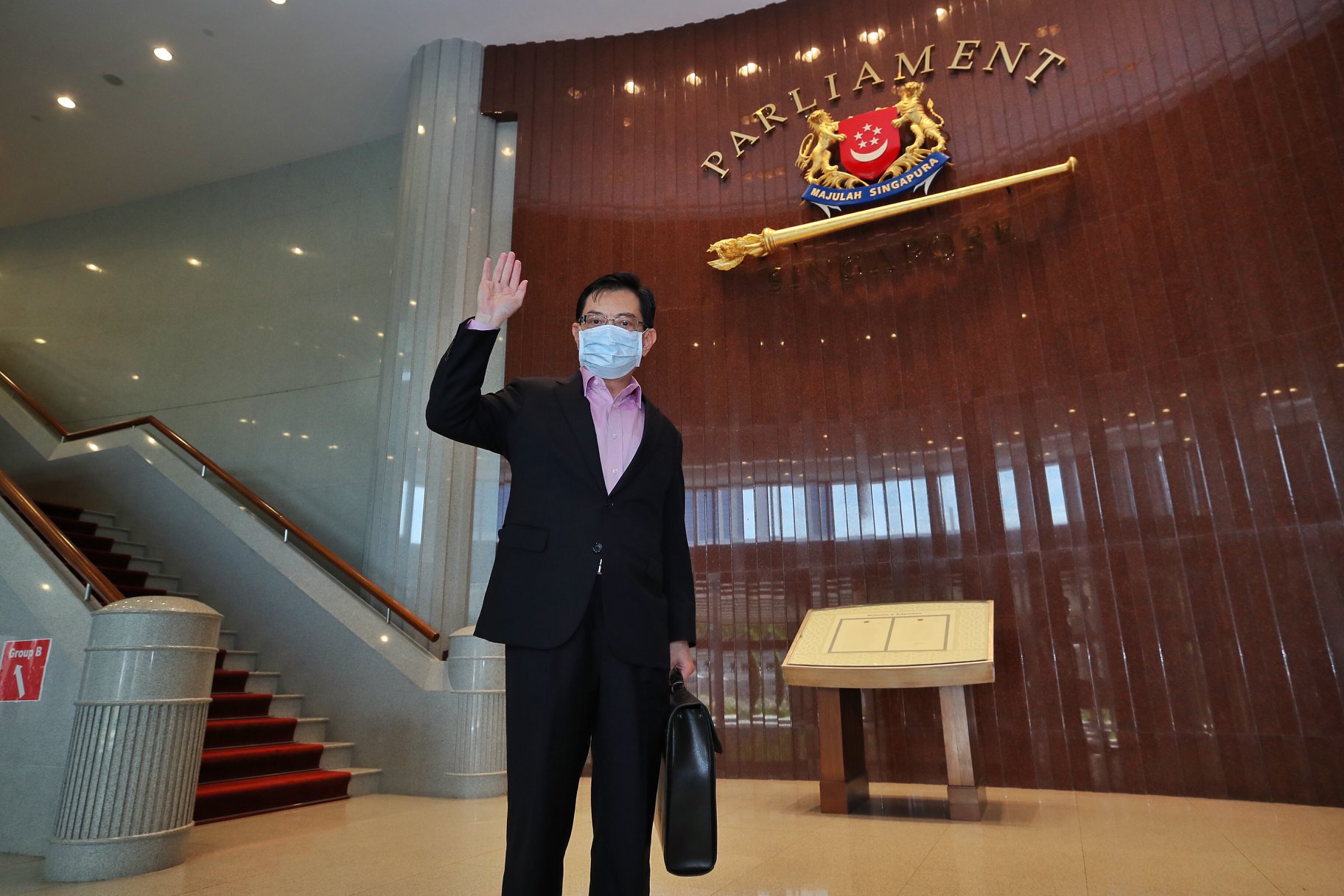
Photo: Heng Swee Keat FB
Deputy Prime Minister Heng Swee Keat announced an additional S$33 billion COVID-19 support package in Parliament today (26 May). Dubbed the 'Fortitude' budget, this latest support package is the fourth support package Singapore has unveiled since the COVID pandemic broke out. Read his speech in full here:
This is my fourth budget this year. I presented the Solidarity Budget in this House
seven weeks ago. At that time, there were about 1.1 million cases and 62,000 deaths due to COVID-19 globally. The situation has since deteriorated sharply.
Globally, over five million people have been infected, and over 340,000 lives
have been lost. More people are expected to be infected as countries come to grips with what it takes to contain this virus.
COVID-19 has disrupted the global economy. Lockdowns and movement restrictions have exerted a huge cost, with major job losses in many economies. In the US, the unemployment rate for April, has increased to 14.7 percent. This is the highest level since the Great Depression. New jobless claims also continue to be high in May.
The Eurozone economy is estimated to have contracted 3.8% in the first quarter of 2020, its sharpest decline on record. The IMF has predicted that Asia will see zero growth in 2020 - the worst growth performance in 60 years. Societies and communities have been severely strained. In some countries, bitter differences over how to deal with the pandemic have deepened societal fault lines.
The road ahead is fraught with uncertainties. The key uncertainty arises from the virus itself. There is still much that we do not know about COVID-19. For example, what is the risk of transmission by asymptomatic carriers? Are recovered patients immune to future infections and if so for how long? Scientists and medical experts are divided.
It is also uncertain how the pandemic will evolve in the coming months. Will there be significant mutations of the virus? Will there be a resurgence in infections as restrictions on activities and travel are gradually lifted around the world? And how soon will a vaccine be ready? There is a wide range of views among experts - from five months to beyond 18 months for a viable vaccine. Making the vaccine available globally will also be a huge challenge.
The situation is fast-evolving, and global efforts at containing the pandemic are uneven and uncoordinated. These uncertainties affect whether and when countries will be able to contain the pandemic successfully. In turn, this affects how far and how fast the global
economy can recover.
Economic Impact on Singapore
As a small and open economy, Singapore's economic outlook depends critically on the state of the global economy. With COVID-19, the global outlook depends on how the global community is able to contain the outbreak.
Our economy has been deeply impacted by the global shocks. This morning, the Ministry of Trade and Industry further downgraded Singapore’s GDP growth forecast from “-4% to -1%” to “-7% to -4%”. Outward-oriented sectors, such as manufacturing, wholesale trade and transportation and storage have been affected by both weak external demand and supply chain disruptions.
The circuit breaker, which was put in place to bring down community transmission decisively, also affected many businesses that could not operate offsite. Based on preliminary estimates, the resident unemployment rate rose to 3.3% in March 2020, the highest since December 2004
.
As announced by the Multi-Ministry Task Force on 19 May, we are preparing to reopen the economy in three phases, guided by public health considerations. As we open up progressively, we will continue to give more support to businesses which are not yet ready to re-open, and to workers who are still unable to resume work. The key is to re-open safely, and this needs to be done carefully.
As we have learnt from the experience of other countries, life will not return to what it was before COVID-19. When we re-open and have more activities and interactions, we are likely to see a rise in community cases.
We must therefore be psychologically prepared for setbacks, before we safely transition to a new normal, and build a COVID-safe nation. Over the coming months as we transition to the next phase, many of our precautionary measures will remain in place. The global economy is unlikely to recover quickly. We must be prepared for tough times in the months ahead.
Challenge for a Generation
This is a challenge for this generation of Singaporeans. It is a test of our strength and fortitude, a test of our resilience and unity. How we respond will define us as a people.
The past few months, especially the circuit breaker, have been tough for everyone. There are worries and anxieties. Some have lost their jobs or suffered pay cuts. Fresh graduates are worried about finding jobs. Mid-career Singaporeans who support both their children and elderly parents, are anxious about job stability.
Businesses are concerned about cash flow and staying afloat. Families have found it challenging to balance working from home and adapting to home-based learning. COVID-19 has also hit the vulnerable groups in the community. We have seen more families seeking counselling for marital conflicts and family violence.
Our path forward will be tough, but we will journey together. Today, I introduce this $33 billion Supplementary Budget for the next phase of our fight against COVID-19.
The central focus of this Budget is jobs. This Budget will continue to support workers and businesses who remain affected by border closures and safe distancing measures. Given the significant changes in the global economy ahead, we will provide support to enable our businesses and workers to adapt, transform and seize new opportunities, to emerge stronger. We aim to enable workers and businesses to go through this difficult period together in a synergistic way.
We will also provide additional support to our households and community to cope with the disruptions, and seize new opportunities in adversity. This will help us build a stronger and more inclusive society.
I will also provide funding to frontline agencies, to continue our fight against the pandemic. This will boost our clinical management of cases, and our swabbing and testing capabilities.
The coming months will test our resolve as a society and as a people. We will need to adapt, and stay resolute and resilient amidst a rapidly evolving, uncertain situation. In that light, I have decided to call this the Fortitude Budget - courage in adversity.
Together with the Unity, Resilience and Solidarity Budgets, we are dedicating close to $100 billion ($92.9 billion) – to support our people in this battle, which is almost 20% (19.2%) of our GDP. This is a landmark package, and a necessary response to an unprecedented crisis.
Part of this Supplementary Budget also provides $3.8 billion for the measures, including the enhancements to the Jobs Support Scheme, announced on 21 April 2020 for the extended circuit breaker period.
A distinctive feature of this Budget is that we are setting aside a bigger contingent sum. We are dealing with unprecedented uncertainty, across all fronts. A bigger contingent sum will allow us to respond swiftly to fast changing situations. I will speak more on this later.
Before I get into the details, I thank our partners - NTUC, Singapore Business Federation, Future Economy Council members, Emerging Stronger Taskforce members, social sector agency partners, and many citizens and groups who have given us useful feedback. Your inputs have been valuable. I also thank my team in MOF who has been working non-stop since our first Unity Budget this year.
PROTECTING LIVELIHOODS, TRANSFORMING BUSINESSES
The central focus of this Budget is jobs. Large parts of the last three Budgets were directed at protecting the livelihoods of our workers. In this Budget, we will do even more.
Today, over 140,000 enterprises employ 1.9 million local employees, across various industries. All these enterprises are facing not only immediate challenges, but also structural changes that threaten their survival. Some of our workers will lose their jobs. Some of these jobs will not come back. Other jobs will look different going into the future.
Our economy is undergoing a sea change. Even as we navigate through the current storm, we must stay on course, and set our direction right, to prevail over the challenges ahead. The tripartite structure that has served Singapore so well over the years will need to be reinforced. Each of us must do our part – businesses need to adapt and transform, and workers need to adapt and re-skill.
You have my assurance that the Government will provide strong support, to bring all parties together to navigate through these turbulent waters.
I will cover these inter-related subjects in three parts. First, how we provide timely support to businesses and workers. Second, how we support businesses to transform to secure the future of our workers. Third, how we help Singaporeans upskill and reskill to seize opportunities – now and in the future.
Supporting Businesses, Saving Jobs
Many businesses have been hard-hit by the simultaneous demand and supply shocks
caused by COVID-19. I had a virtual meeting with the Singapore Business Federation and the Future Economy Council members last week. While businesses appreciated the support over the past three Budgets, they recognised that the Government cannot carry businesses indefinitely.
Businesses are trying hard to get back on their feet and re-open safely as they emerge from the circuit breaker. We are fully behind them, and will further strengthen our support for businesses on the 3Cs – cash flow, costs, and credit.
Cash Flow
Extending the JSS
I will help businesses on the first “C”, cash flow, through the Jobs Support Scheme, or
JSS, which supports firms in retaining and paying their workers. When the circuit breaker was imposed, I increased the wage support under the JSS to 75% of the first $4,600 of wages in April for every local employee.
When the circuit breaker was extended in May, I extended the higher level of support to May. This is because most firms had to either stop operating or operate at a much reduced level. This temporary increase in support was planned for only two months.
Coming out of the circuit breaker, businesses will not be able to return immediately to pre-circuit breaker levels of operations. Hence, I reviewed the original JSS schedule and will make three enhancements to the scheme. With your permission, Mr Speaker, may I ask the Clerks to distribute a summary to all Members of this House.
The first enhancement is to increase the duration of JSS payouts by one month for all firms. I previously announced that the JSS would cover nine months until October 2020, computed based on wages paid to local employees up to July 2020. To provide additional relief for firms as they safely re-open after the circuit breaker period, I will provide an additional month of support. This will be computed based on the wages paid in August 2020.
This support will be at the same levels as those provided during the non-circuit breaker months. Firms will receive this additional month of support in the October 2020 JSS payout.
The second enhancement is for firms that cannot resume operations immediately after the circuit breaker. For such firms, I will continue providing wage support at 75% until August
2020 or when they are allowed to re-open, whichever is earlier. This includes retail outlets, gym and fitness studios, and cinemas.
The third enhancement is to refine the classification of firms in the different JSS tiers. This arose from feedback from industry associations and businesses. I will increase the level of wage support for firms in sectors that are more severely impacted, from the previous 25%, to either 75% or 50%.
Firms in the aerospace sector including those in Maintenance, Repair, and Operations, will now receive 75% wage support. Firms in the retail, and marine and offshore sectors will now receive 50% support. The full list of eligible sectors and the qualifying criteria are in the Annex.
Eligible firms will receive a back-payment to top up their previous JSS payouts to the higher level of support. This retrospective payment will be made by July. For the built environment sector, which includes construction, we will raise the wage support to 75%. This sector will be affected by the phased and gradual resumption of activities. This 75% support will only apply to wages paid between June and August.
In total, these three enhancements to the JSS will cost $2.9 billion. Through the JSS, we are flowing a total of $23.5 billion to firms to support wage costs for 10 months.
I urge leaders in our industries to use this additional cushion to retain your staff, speed up adaptation, and move towards a viable business model. Please make full use of the schemes available to train workers and upgrade your corporate capabilities. Time is running out, please act fast!
I am heartened that some firms which have not been as badly affected by the pandemic have returned or donated their JSS payouts. Thank you! I encourage other firms that are able, to do so as well.
Costs
Other Support for Labour Costs
I will also provide support to businesses for the second “C”, costs. During the circuit breaker period, we provided a Foreign Worker Levy waiver and rebate to support businesses employing migrant workers that had to suspend operations.
Some businesses will not be allowed to resume operations on-site immediately after the circuit breaker is lifted. I will extend the Foreign Worker Levy waiver and rebate for up to two months for such businesses. This will include all businesses in the construction, marine and offshore, and process sectors.
The waiver will be 100% in June, and 50% in July. The rebate will be $750 in June, and $375 in July.
Deferring Increase in CPF Contribution Rates for Senior Workers
To help businesses manage costs in these challenging times, the Government will defer the planned increase in CPF contribution rates for senior workers by one year, from 1 January 2021 to 1 January 2022. The CPF Transition Offset scheme will similarly be deferred until after the higher contribution rates take effect.
I thank the NTUC and the Singapore National Employers Federation for supporting this.
Expanding Rental Relief for SMEs
Many businesses have also given feedback that while the JSS provides support on wage costs, they are facing difficulties with rental costs. This is especially tough on SMEs.
Given that businesses will need more time and support to get back on their feet post circuit breaker, we will now do more. We will significantly add to the support for rental costs earlier provided through the Property Tax Rebate for 2020 in the Unity and Resilience Budgets. We will also expect landlords to do something, and that will be legislated.
First, I will provide a cash grant to offset the rental costs of SME tenants, to be disbursed through property owners. Taken together with the Property Tax Rebate, the Government will, in effect, offset about two months of rental for qualifying SME tenants of commercial properties, and about one month for qualifying SME tenants of industrial and office properties.
The grant will be disbursed automatically to property owners from end-July. This grant will cost about $2 billion. Details are in the Annex.
Second, the Minister for Law will introduce a new Bill next week. This will mandate that landlords contribute by granting a rental waiver to their SME tenants who have suffered a significant revenue drop in the past few months.
We deliberated on this matter very carefully. The Government does not ordinarily intervene in contracts after they have been entered into. However, as the Minister for Law had explained in his Second Reading Speech on the COVID-19 (Temporary Measures) Bill, in exceptional situations such as this, the Government needs to intervene, through legislation, with temporary targeted steps to safeguard the economic structure for the common good.
The new Bill will also cover provisions on temporary relief from onerous contractual terms such as excessive late payment interest or charges. It will also allow tenants to repay their arrears through instalments.
If the Bill is passed by Parliament, SME tenants in commercial properties who have suffered a significant revenue drop will benefit from a total of four months of rental relief – shared equally between the Government and landlords. Other SME tenants in industrial and office properties will also be given some relief. SMEs also already benefit from temporary relief from rental payment obligations till October. Together, these will provide substantial support on rental costs, for our SMEs.
Extending Rental Relief for Government Tenants
The Government will also continue to lead by example in supporting our tenants. I will provide two more months of rental waivers for commercial tenants and hawkers. The total rental waiver will now be four months for commercial tenants. Stallholders in hawker centres and markets managed by Government agencies will get a total of five months of rental waivers.
For industrial, office, and agricultural tenants of Government agencies, I will provide one more month of rental waiver. They will now receive a total of two months of rental waiver. We will also ensure that these measures flow through to help sub-tenants, many of whom are SMEs. This will dovetail with measures for SMEs being studied by the Minister for Law.
Credit
Enhancing Financing Support
Let me move to the last “C”, credit. We introduced and enhanced various financing schemes such as the Temporary Bridging Loan Programme and the Enterprise Financing Scheme in the past Budgets. The take-up has been high. The schemes have catalysed $4.5 billion of loans so far, benefiting 5,000 businesses. This is more than three times the amount of loans catalysed for the whole of 2019.
MAS, together with banks, finance companies, and insurers, has also introduced relief measures. These help individuals and SMEs to continue servicing their loans and paying for insurance coverage.
Notwithstanding this enhanced support, business leaders, including at my virtual meeting with the Singapore Business Federation and the Future Economy Council, tell me that in this environment, some promising startups in Singapore are finding it hard to raise capital and develop their business. Left unaddressed, this could set back our efforts and result in the loss of good jobs and good companies. It is important to preserve what has been built up in our innovation ecosystem so painstakingly over the years.
To bridge this financing gap, I will provide financing support for promising startups. This will help them sustain their innovation and entrepreneurship activities.
I will set aside $285 million, to catalyse and crowd in at least another $285 million in matching private investments. This is in addition to the $300 million I had set aside under the Unity Budget for deep-tech startups to gain better access to capital, expertise, and industry networks under Startup SG Equity.
These startups can also make full use of the SGUnited Traineeship scheme, which I will cover later, to bring in graduating students with deep interests in the fields they are exploring, and build up our talent base.
Sector-Specific Support
Government agencies have also been rolling out support packages to address other sector-specific needs. We have introduced packages for the aviation, tourism, land transport, arts
and culture, financial, and maritime sectors.
Support for the Built Environment Sector
We will introduce further support for the built environment sector, which includes construction. There are many significant infrastructure projects, including public infrastructure such as MRT lines and public housing that we must continue to plan and build.
I have covered the higher tier of JSS support for locals who are in this sector, including project managers, engineers, architects, draughtsman and quantity surveyors. I have also covered the Foreign Worker Levy rebate and waiver to support businesses in this sector, so that they can continue to play their part in building Singapore.
I will now provide support to co-share the additional costs that will be incurred by businesses who will need to meet additional requirements in order to resume their existing projects safely.
The Minister for National Development and BCA will announce the details later.
Businesses Facing Longer-term Challenges
Taken together, our support in past Budgets and this Fortitude Budget will help tide businesses through their periods of closure, and to retain and rebuild core capabilities. Based on our current re-opening plans, we expect most businesses to re-open by July. This support would enable most sectors to recover in the coming months.
But some sectors, such as aviation and tourism, will take longer to re-open fully, given the restrictions on global travel for the foreseeable future. The Government will consider providing additional help, depending on the situation and longer-term shape of these industries, and plans for the economy. In the interim, I urge businesses to make good use of the existing support and consider how to transform for a postCOVID world.
Transforming to Seize New Opportunities
I have covered the support that we are providing to businesses in the near term, to save jobs. But we must also think ahead. To ensure good job opportunities remain available for Singaporeans, we must work to build strong and viable businesses for the future.
I set up the Emerging Stronger Taskforce to plan for the post-COVID world to study how we can emerge stronger. The Emerging Stronger Taskforce will work with the Future Economy Council Sub-Committees to study how sectors, can adjust to the many changes that are coming. They will draw on support from industry experts and consultancy firms to come up with actionable recommendations.
For the sectors that are more badly hit, and which also face significant structural disruptions, we will undertake a review on the medium-term outlook, and our responses to adapt to the changes ahead.
After observing companies for several years now since we started work on the Future Economy, I found that companies that are adapting to structural changes early are also adapting better to this sudden shock. If change is a constant, innovation and resilience are simply manifestations of our ability to deal with change – be it persistent or sudden.
The Taskforce is studying two key shifts:
- The rise of digital transformation, and
- The decline in support for globalisation, and shifts in global supply chains.
These shifts were already taking place, but COVID-19 has accelerated them. Our businesses must adapt, and we will support them in this.
Building on the Momentum Of Digital Transformation
The first key shift is digital transformation. We will not go back to our old ways. Digital solutions will become more deeply embedded in our lives. Telecommuting, on-demand food and services, and virtual events are now the norm.
A McKinsey study shows that we have seen the equivalent of five years of consumer and business digital adoption in just eight weeks since the COVID-19 pandemic started. Indeed, COVID-19 has done what many CEOs and CTOs found hard to do. Accelerate digitalisation!
This is a good thing. But I know that many businesses fear being left behind and shut out of the future. Businesses that are not digitally connected have been hit hard during the circuit breaker.
Earlier, we had been supporting businesses strongly to go digital. I am glad that businesses are now taking this seriously. To accelerate change, I will allocate more than $500 million to support businesses in their digital transformation. Those who are willing to transform will not be left behind. Our augmented support for digital transformation in this Budget has three prongs.
Support for E-payments
First, for those who have not begun using digital tools, we will help them to get on board with digital transformation, building on current momentum. For example, in e-payments, the take-up by businesses has risen sharply – 50,000 more businesses have adopted PayNow Corporate since April this year.
IMDA, NEA, JTC, HDB, and Enterprise Singapore will provide a bonus of $300 per month over five months to encourage more stallholders in hawker centres, wet markets, coffee shops, and industrial canteens to use e-payments and avoid having to handle cash. They should not be left behind as the whole economy transforms.
Digital Resilience Bonus
Second, we will enhance our support for businesses which are ready to take their basic payment and invoicing functions digital. This will be coupled with support to keep their business running and even acquire new revenue lines. We will help businesses to implement safe management measures and business continuity strategies to adapt to new post-COVID norms, an area that the Singapore Business Federation suggested supporting.
We had earlier enhanced SMEs Go Digital to help businesses adopt digital solutions to cope with circuit breaker measures. Under SMEs Go Digital, we have rolled out the Food Delivery and e-commerce Booster Packages. More than 10,000 food services and retail establishments have benefited from these packages and gone online.
To give a further boost, we will introduce a Digital Resilience Bonus to help businesses take their next step to digitalise. We will start with the F&B and retail sectors, which are most affected by the safe distancing requirements as we re-open the economy.
Eligible businesses can receive a payout of up to $5,000 if they adopt PayNow Corporate and e-invoicing, as well as business process or e-commerce solutions. Details are in the Annex.
Third, businesses which already have basic digital capabilities, should deepen their digital transformation. We will help them make use of advanced digital tools in an integrated way.
The Digital Resilience Bonus will have an additional tier of $5,000 for F&B and retail businesses which also incorporate advanced solutions.
I will also set aside $250 million to help businesses digitalise in partnership with platform solution providers and industry champions. For example, developing Offline-to-Online business models to access new domestic revenue streams and international demand. This will mitigate the impact of COVID-19 on revenues.
Apart from businesses, our schools and Institutes of Higher Learning must also make full use of digital technologies for learning. MOE has been doing this from the time I was Education Minister. The Student Learning Space (or SLS), designed as a platform for self-directed learning, has been instrumental in supporting our teachers for home-based learning during the Circuit Breaker.
The Government will harness the talents of our best software engineers, AI experts, learning scientists and educators to develop the relevant pedagogy and build new digital platforms for online teaching and learning, and integrate the latest advancements in AI and learning sciences. The National Research Foundation and MOE will provide more details later.
National Innovation Challenges
We are committing our fullest support to help our businesses ride the wave of digital transformation. But success will require strong partnerships across the economy. To catalyse partnerships, we will introduce a set of National Innovation Challenges, riding on the success of the Open Innovation Platform.
With the National Innovation Challenges, we will focus on partnerships to develop industry-led solutions to the challenges that all businesses are grappling with: starting with how we can reopen Singapore safely – to achieve safe workplaces, safe homes, safe schools, and safe commuting.
The relevant agencies will articulate the critical problems that we seek to solve,
or the leap that we hope to make. We hope that corporates, startups and others in the private and people sectors can step forward to form partnerships to provide solutions that can be scaled. The Government will provide support for this innovation drive.
The National Research Foundation and the Ministers for Communications and Information and for Trade and Industry will share more details on these initiatives later.
Seizing Opportunities Amid Global Shifts
COVID-19 has also accelerated the decline in support for globalisation, and disrupted supply chains. Governments and businesses are re-evaluating their risks. There will be a premium on resilience. In this new world, we must continue to build on our reputation as a trusted, neutral, and reliable Global-Asia node.
Last month, Singapore issued a Joint Ministerial Statement alongside 10 other countries affirming our commitment to upholding supply chain connectivity and resilience during the COVID-19 situation. These links will support our businesses to go digital and global. By staying successful, they will create good jobs for our people.
For example, in the Networked Trade Platform or NTP, we have set up customs declaration data exchanges with countries in the region and further afield, such as Australia, China, and the Netherlands to facilitate trade.
Our Grow Digital programme is also helping SMEs to access overseas markets through e-commerce platforms.
Creating Good Jobs, Upskilling for the Future
I have spoken on the first two thrusts – providing timely support for our businesses, and accelerating transformation. By supporting our businesses to stay viable, they save jobs and also create good jobs for the future.
I now turn to the third thrust, the key focus of this Budget, on supporting our workers
to secure these opportunities. An adaptable and skilled workforce will in turn power our businesses. We must achieve this synergy.
In the tough months ahead, we must be prepared for some job losses. While we will try to preserve jobs in the midst of this crisis, we cannot protect every job. However, you have my assurance that the Government will protect every worker.
Our promise to workers is this. As long as you are willing to pick up new skills and adapt, to access available opportunities to work or learn, the Government will provide our strongest support to help you. Over the years, we have built up a strong base of support to help workers train and get good jobs, especially in sectors with growth potential.
In the Unity Budget, I announced enhancements, in the form of the Next Bound of SkillsFuture. This included the SkillsFuture Mid-Career Support Package. I also enhanced our placement and training programmes in the Unity and Resilience Budgets, to boost support for our workers in sectors that were more severely affected early in the COVID-19 outbreak.
SGUnited Jobs and Skills Package
In this Budget, I will launch an SGUnited Jobs and Skills Package, to create close to 100,000 opportunities in three areas – 40,000 jobs, 25,000 traineeships and 30,000 skills training. This will support the immediate needs of our workers, and raise the skills of our people for future jobs.
Together, these cater to workers with different skill levels and career aspirations, and to the needs of diverse firms across industries.
Jobs
The first component in this SGUnited Jobs and Skills Package is Jobs. We will continue to expand the number of job opportunities, in both the public and private sectors, to more than 40,000.
The public sector will bring forward our hiring to meet long-term needs, like early childhood education, healthcare and long-term care. Together with jobs to meet short-term needs related to COVID-19 operations, such as healthcare declaration assistants and swabbers, the public sector will create 15,000 jobs.
Our agencies will also work with businesses to create 25,000 jobs. Many businesses have stepped forward, with openings in a wide range of job roles, such as computer engineers, and machine operators. I encourage more businesses to do even more in the coming months.
To equip our people to take on these jobs, we will expand capacity in career conversion programmes, such as in Place-and-Train conversion programmes under the Adapt and Grow Initiative, and Company-Led Training programmes under the TechSkills Accelerator or TeSA initiative.
TeSA has been successful since its launch in Budget 2016. As of Dec 2019, over a thousand have been trained in partnership with industry leaders such as Accenture, DBS Bank, and Google. Over 90% of them have been emplaced in ICT-related roles. I look forward to more industry partners coming on board, to help prepare more Singaporeans for a future where digitalisation becomes increasingly important.
Traineeships
The second component in this SGUnited Jobs and Skills Package is traineeships. We will provide job seekers with a wider range of traineeships to gain industry-relevant experience. Trainees may be emplaced in jobs with their host companies at the end of their traineeships. Even if they do not, they would have learnt valuable skills for other jobs.
In total, we target to create about 25,000 traineeship positions this year. Of this, 21,000 will be from the SGUnited Traineeships programme, and another 4,000 places from a new SGUnited Mid-Career Traineeships scheme.
Let me elaborate. In the Resilience Budget, I announced the SGUnited Traineeships programme targeted at our local first-time job seekers, where WSG funds the training allowances with host companies, for up to 12 months.
I am glad to see strong interest from more than a thousand host companies. The public sector is also keen to offer new traineeship opportunities. With this momentum, I will more than double the provision, to provide 21,000 traineeships this year.
To support our technology and innovation drive, these traineeships will include technology-related areas that are in high demand or emerging rapidly. DSTA will offer diploma holders the opportunity to build skills in fast-growing technology areas like IT and engineering.
Agencies in our research and development sector, including our universities, A*STAR research institutes, AI Singapore, and SGInnovate will work with local deep-tech companies and start-ups for trainees to work with industry partners on real-world science and technology projects. These will include areas such as software learning and AI.
As earlier announced by the Minister for Manpower, these traineeships will be progressively offered from 1 June this year.
We will pay special attention to mid-career job seekers. We understand that many are worried about their job prospects. Hence, we will create a new SGUnited Mid-Career Traineeships scheme for unemployed mid-career job seekers.
Our agencies will work with interested companies to provide 4,000 traineeships for our mid-career job seekers. This scheme specifically caters to the needs of mid-career individuals, to learn new skills and embark on new careers.
Also included under the Traineeships category are WSG's Attach-and-Train programmes under the Adapt and Grow Initiative targeted at mid-career individuals. We will also scale these up, to provide meaningful traineeship opportunities.
Skills
The third component in the SGUnited Jobs and Skills Package is a new SGUnited Skills programme, to expand training capacity for about 30,000 job seekers this year. Job seekers can upgrade their skills while looking for a job.
Participants of this SGUnited Skills programme will take industry-relevant and certifiable training courses full-time, at highly subsidised rates. The course fees can be substantially, if not fully offset by their SkillsFuture Credit. The courses will be delivered by companies and Continuing Education Training (CET) Centres, including Institutes of Higher Learning.
Job seekers will be given opportunities to apply their training, through attachments or participation in company projects. They will also be provided with career guidance and job placement support. They will also receive a training allowance of $1,200 per month during the course of their training. This will help them focus on their training and job search. This programme will be rolled out progressively from July 2020.
Additional Support for Hiring
The fourth component – a horizontal layer, of our SGUnited Jobs and Skills Package is a hiring incentive. Ultimately, our traineeships and skills training are to help our people to secure jobs. In these uncertain times, I understand why many employers, even if they are doing well, are reluctant to hire.
To support employers in hiring, I will provide a hiring incentive to employers to hire local workers who have gone through eligible traineeship and training schemes.
In the Unity Budget, I announced a hiring incentive under the SkillsFuture Mid-Career Support Package. For eligible workers aged 40 and above, I will double the incentive to cover 40% of their salary over six months, capped at $12,000 in total.
Together with other support such as the special SkillsFuture Credit top-up of $500 to every Singaporean aged 40 to 60 in 2020, we are providing specially enhanced support for jobs and training for this group. If needed, they can also benefit from other support schemes this period, such as the COVID-19 Support Grant.
Further, I will also expand the hiring incentive to cover workers of all ages. For eligible workers under 40, this incentive will cover 20% of their monthly salary over six months, capped at $6,000 in total.
I am greatly encouraged by how our tripartite partners are working together, going all out to provide strong support to our jobs and skills initiatives. The Singapore Business Federation is currently the programme manager for SGUnited Traineeships. They are working hard to bring as many host companies on board, and as quickly as possible.
NTUC, besides supporting current workers, is reaching out to fresh graduates through the Young NTUC Movement, to consider the SGUnited Traineeships programme as an option after graduation.
Some employers have stepped forward to offer jobs and traineeships. This not only contributes to the national effort, but is also a farsighted move to build longer-term capabilities for their companies. I encourage employers to also make good use of the strong support we provide to upskill their existing workers during this downtime, so that they can emerge stronger when business picks up.
In total, to deal with the impact of COVID-19 on jobs, I will set aside about $2 billion for the SGUnited Jobs and Skills Package this year to strengthen employment and training support for our workers. Details are in the Annex.
Members will appreciate the range of schemes in the SGUnited Jobs and Skills Package. I have set out the broad strategy. To ensure that the strategy can be implemented well, and to sustain the momentum of current efforts, careful design of the schemes and attention to implementation details are critical.
Senior Minister Tharman Shanmugaratnam, as Coordinating Minister for Social Policies, and former Finance as well as Education Minister, has both detailed knowledge and deep expertise in this issue. I have requested him to chair a National Jobs Council to oversee this very important work, and I thank him for agreeing.
The National Jobs Council will be focussed on creating jobs and building deep skills. This important effort will be integrated with the work of the Future Economy Council on the overall upgrading of our economy, through the Industry Transformation Maps in each cluster. In this way, we can marshall all our experiences and expertise to manage the huge changes that are coming our way. The National Jobs Council will provide details later.
SUPPORTING HOUSEHOLDS, BUILDING AN INCLUSIVE COMMUNITY
Strengthening Solidarity
I have spoken about what we will do to protect livelihoods, create new opportunities, and help our workers access good jobs. I now turn to how we will protect our families and the community, and to help Singaporeans cope during this period of uncertainty.
In the last three Budgets, we provided direct support to all Singaporeans, and provided more for the lower income. During the month of April, the Temporary Relief Fund assisted 450,000 individuals who were in need of immediate financial help, before other support schemes came on stream.
Many have written to my colleagues and I to express their appreciation for the help received. We are glad that you have found this helpful. Additional Funding for COVID-19 Support Grant We will continue to provide help for immediate needs. The COVID-19 Support Grant is now in place.
It covers those who have lost their jobs, are placed on no-pay leave, or will see salaries significantly reduced in the coming months due to COVID-19. In the three weeks after the COVID-19 Support Grant started, we received about 46,000 applications. We are committed to providing help to those who have been badly affected.
To strengthen support for our families, I will set aside another $800 million for the COVID-19 Support Grant.
For self-employed persons, we are providing direct cash assistance through the Self-Employed Person Income Relief Scheme, or SIRS. Over 100,000 self-employed persons will be receiving their first payout of $3,000 this week.
Self-employed persons who do not automatically qualify or have marginally missed the criteria can approach NTUC. So far, NTUC has received over 60,000 applications, and is working hard to process them. Applicants can expect to hear from NTUC within a month of submitting their application.
I also encourage all self-employed persons to make full use of the SEP Training Support Scheme to train and upskill. Some self-employed persons are re-assessing their career options, looking at industries which are hiring. We will support you to access training programmes to make the transition.
Care and Support Package for Households
To help all Singaporeans with their household expenses during this period of uncertainty, I introduced a comprehensive Care and Support Package in my previous Budgets.
Adult Singaporeans would have received their Solidarity Payment of $600 in cash. I am encouraged to hear that some have donated the payout to help others with greater needs.
The Care and Support Package has other components that will flow in the coming months. For instance, lower- and middle-income Singaporeans will be receiving their remaining Care and Support - Cash payout of $300 or $600 in June. Parents with young Singaporean children will also receive the $300 cash payout at the same time.
These are on top of permanent support schemes, such as the GST Voucher-Cash, which will be paid out in August.
Solidarity Utilities Credit
Earlier, I announced in the Unity Budget that I would double the amount of U-Save rebates through a one-off GST Voucher – U-Save Special Payment, for all eligible HDB households, to help with utilities bills. Larger households with five or more members get more, and can receive up to $1,000 in U-Save rebates this year.
Newsletter
Get updates straight to your inbox
Singaporeans have given feedback that while they are saving on transport fares and other charges, they are expecting to spend more on their utility bills, as they stay home during the circuit breaker period.
To thank all Singaporeans for doing our part in staying home for Singapore, I will provide a one-off $100 Solidarity Utilities Credit to each household with at least one Singapore Citizen. This will cover all property types and will be credited in the July or August utilities bill.
Altogether, we have put in place numerous schemes to tide our households through this period. With your permission, Mr Speaker, may I ask the Clerks to distribute the household support summary to all Members of this House.
Strengthening Social Resilience Through Digital Inclusion
During the stay-home period, families are making fuller use of digital technology - for home-based learning, entertainment, ordering meals, and keeping in touch with families, and friends. The value of access to digital technology is clear. During COVID-19, being able to connect with each other safely has enabled support, especially for vulnerable members of our community.
In a post-COVID world, having all on board digital channels will open up exciting new possibilities for different members of the community to engage with and support each other.
Going forward, digital inclusion should be an important way for us to strengthen social resilience. Regardless of age or resources, all members of our society should have access to digital resources, with no one left behind. To this end, we will provide help for specific groups.
Students
The first group is our students, who have gone through about four weeks of home-based learning during the circuit breaker. To support students from lower-income families, who may not have digital access at home, MOE loaned over 22,000 computing devices and internet dongles to enable all students to benefit from full home-based learning and continue to connect with their teachers and friends.
As part of longer-term plans to support digital literacy for all students, MOE will accelerate the timeline for all secondary school students to own a digital learning device. The Minister for Education will announce details when ready.
Seniors Go Digital Movement
Another group is our seniors. Seniors, who are more vulnerable if infected, are staying home during this period, and many will have to continue doing so, to protect themselves from COVID-19. But such isolation can affect their health.
The Silver Generation Office has been keeping in touch with seniors with care needs and weaker family support through telephone, and will continue to do so.
To enable seniors to stay in contact with their families and friends, and for our care
teams and volunteers to reach out more effectively, IMDA will launch a Seniors Go Digital movement to support seniors to adopt digital channels, and equip them with the digital skills to do so. This will require all-round support from family, friends, and the wider
community.
We will launch a Digital Ambassadors movement, to rally the community and volunteers to support our seniors to acquire digital skills. For seniors from lower-income households who wish to learn but are unable to afford the devices, we will also provide them with financial support.
I strongly encourage our youths who have the digital skills, as well as corporates, to step forward to reach out. The Minister for Communications and Information and IMDA will share more details later.
Transforming our Community and Social Service Agencies
Besides digital inclusion, another pillar for social resilience is our social service agencies and charities. They are key partners who have been supporting families and vulnerable
groups during this period. In the years ahead, a stronger social service sector will be even more critical.
Turning Challenges into Strengths
Last Saturday, Ministers Grace Fu, Indranee and Desmond joined me in a video conference with leaders of our social service agencies. They shared with us how they have been using digital means to reach out to the diverse clients they are serving. It has not been easy, but they tried and found it useful.
We are very encouraged by their can-do spirit. Many found, in their words, “opportunities in adversity”, and were able to “turn the challenges during the circuit breaker into new areas of strength”.
While these cannot replace the human touch, they found digital tools, a useful complement that would help them better reach out to their clients even after the circuit breaker.
To serve their clients better, several social service agencies have started on the digitalisation journey, and many want to press ahead with their transformation. For example, Project Belanja! by Food from the Heart. Beneficiaries can simply scan a QR code at partner food stalls to obtain a hot meal, instead of having volunteers go door-to-door to deliver food.
This creative idea supports our hawkers and allows beneficiaries to get freshly cooked food, while our social service agencies save costs and reduce food wastage.
To support the building of digital capabilities as a key priority, the National Council of Social Service, or NCSS, is mobilising corporate partners to lend their expertise. Many have stepped up, including ThunderQuote which developed self-help guides on remote working tools and TechLadies which provides general consultancy.
MSF and NCSS will continue to support the social service sector in building capabilities. Funding is currently available through the VWO-Charities Capability Fund. In future, these initiatives can also be funded by the Community Capability Trust, which I announced at the Unity Budget.
Increased Matching for Enhanced Fund-Raising Programme
While continuing to be passionate about supporting the vulnerable in our community, our charities and social service agencies are facing difficulties. The leaders appreciate the support from the Jobs Support Scheme, but they are facing falling donations. To provide more support for our charities amidst COVID-19, the Government will partner the Tote Board to enhance the matching for donations through Tote Board’s Enhanced Fund-Raising Programme.
Charities can apply to receive dollar-for-dollar matching on eligible donations, which are raised from projects in FY2020, up to a cap of $250,000 per charity. This includes donations raised through approved digital platforms.
To enable this, I will provide a top-up of $100 million, to add to the existing $70 million budget for the Enhanced Fund-Raising Programme. I strongly urge Singaporeans and residents in Singapore who are able, to donate generously.
Top-up to Invictus Fund
NCSS had earlier set up the Invictus Fund to provide additional support to social service agencies. This Fund will support our social service agencies to maintain service continuity, retain staff, and adopt technology to transform their work.
To enhance support for our social service agencies, I will provide a top-up of $18 million to the Invictus Fund. Details are in the Annex.
I urge our social service agencies to accelerate their digitalisation efforts, scale up capabilities, and share resources and efforts to solve common challenges. We will continue to provide our strongest support for you.
FISCAL IMPLICATIONS
Mr Speaker Sir, this Fortitude Budget will commit a total of $33 billion to support the next phase of our fight against COVID-19, and to position ourselves to emerge stronger.
Together with the Unity, Resilience and Solidarity Budgets, we are dedicating $92.9 billion or 19.2% of our GDP, to support our people in this battle. The Overall Budget Deficit for FY2020 will increase to $74.3 billion, or 15.4% of GDP. This is the largest Overall Budget Deficit in Singapore’s history since our independence. Details are in the Annex.
Use of Past Reserves
This Fortitude Budget will be funded out of Past Reserves. This is the second draw on Past Reserves this financial year. Our Past Reserves are our strategic asset, built up through the prudence and hard work of our people, across generations.
The Government has always upheld the principle that our Past Reserves are to be used only in exceptional circumstances. For the Unity, Resilience and Solidarity Budgets, we used up almost all our accumulated surpluses since the start of this term of Government. But what we need to deal effectively with COVID-19 has grown so much that we have no choice but to draw on our Past Reserves.
In our fight against COVID-19, our Past Reserves have been critical in enabling us to respond comprehensively and robustly to the situation at hand. We will have to deploy it in a deliberate manner, and at decisive moments, in this battle against COVID-19.
In the earlier Resilience and Solidarity Budgets, the President gave approval to draw up to $21 billion from our Past Reserves. This allowed us to safeguard jobs, keep the economy going, and provide direct assistance to Singaporeans during this difficult period.
I also told Members then, that I was prepared to propose to the President to make further draws on Past Reserves, should it be necessary.
Since the Resilience and Solidarity Budgets, the impact of COVID-19 on Singapore has
deepened. Lives and livelihoods are at stake, and we are moving to secure our future. After a challenging circuit breaker period, we are now preparing to re-open our economy. To do so in a safe and calibrated manner, and to continue to support our people, we are proposing a further draw on our Past Reserves.
The Prime Minister met with the President to share the Government’s considerations. Ministers Gan Kim Yong, Lawrence Wong, Chan Chun Sing, and Indranee Rajah joined me last week, to brief the President and the Council of Presidential Advisers (CPA) on the Government’s assessment of the situation, the details of the measures and the resources needed.
The President, in consultation with the CPA, has given her in-principle support for a further draw of $31 billion from our Past Reserves to fund the measures in this Budget.
As President Halimah stated in a Facebook post yesterday, “Indeed, this crisis is unprecedented. Lives and livelihoods continue to be at stake… Having deliberated and considered the recommendation of the CPA, I am satisfied that the fourth support package is necessary… I have therefore given my in-principle support for the proposed measures to draw on the Government’s past reserves.”
Altogether, we are looking at drawing up to a total of $52 billion from Past Reserves this financial year to enable Singaporeans to tide through this crisis and emerge stronger. This is a very significant amount, necessitated by the very exceptional nature of the COVID-19 crisis. I thank President Halimah, Chairman Eddie Teo and members of the CPA for their support.
Members of this House know how strict I have been on prudence, and my Ministry’s emphasis on value-for-money spending. The Public Accounts Committee has also been scrutinising the Government’s expenditure.
I have deliberated long and hard on the measures, and went through many rounds of deliberations with my staff. I have also discussed with PM and my Cabinet colleagues before finalising this set of measures. It has been an unprecedented crisis that is still changing rapidly.
But I am grateful that we have the fiscal resources to mount this response, and the unity, resilience and solidarity of our people to battle this together. We have a responsibility to make the best use of these resources, to keep our people safe, to save jobs and transform businesses, and to emerge stronger.
Every dollar that we have saved has been saved by careful counting over the years. In spending this national savings now, we must make every dollar spent count.
Contingent Budgeting
While we have the resources and the will to do what is needed in fighting COVID-19, we must continue to stay nimble and adaptive in this rapidly evolving situation. To cater for urgent and unforeseen expenditure needs which have yet to be provided for under the Supply Act, the Constitution provides for Parliament to create Contingencies Funds.
Each year, in our annual Budget, we set aside a total of $3 billion as a buffer in the Contingencies Fund and the Development Contingencies Fund.
With COVID-19, we are facing unprecedented levels of uncertainty – it is uncertain how the pandemic will evolve, if there will be a second or even third wave, and if, and when, vaccines will be available. The uncertainty on the medical front is fuelling the uncertainty in the global economy.
Members will appreciate that within less than four months, we are deploying four Budgets to protect Singapore and Singaporeans. To meet this unprecedented level of uncertainty, we will set aside a larger sum in the Contingencies Funds, so that we can respond to urgent and unforeseen needs swiftly.
Having briefed Cabinet, the President and the CPA, I will set aside an additional $13 billion in the Contingencies Funds. This will allow the Government to respond quickly to any unforeseeable developments arising from COVID-19.
This could include public health or fiscal measures that have to be put in place quickly, if the medical or economic situation deteriorates. We will do our best to avoid this, but we must be prepared for any eventuality.
The use of the Contingencies Funds is subject to proper governance and accountability. Under the Constitution, the Minister for Finance may make advances from the Contingencies Funds if the Minister is satisfied that there is an urgent and unforeseen need for expenditure, and the President concurs with the making of such advances.
Thereafter, the amount advanced shall be included in a Supplementary Supply Bill or Final Supply Bill, which will be presented to and voted on by Parliament, as soon as practicable. This approach is appropriate and prudent, given the fluid situation which may require the Government to act swiftly in the coming months.
--
ANNEXES may be viewed here.