
Gender equality group asks Government to grant LTVP with right to work for all foreign spouses


The following is a press release by AWARE, a gender equality advocacy group.
--
Home, truly: respect the rights of foreign wives
Singapore declares itself “pro-family”, and our leaders emphasise the need for migrants to integrate with citizens. Yet policies discriminate against the foreign spouses of citizens, destabilising their families and entrenching their social exclusion in areas of basic need.
This particularly affects foreign wives. As their citizen husbands tend to be low income, their families are marginalised twice over: Policies favour wealthier transnational families; With less wealth, it is harder to circumvent the social barriers resulting from policies. This issue is of growing urgency as the number of such marriages is significant.
The right to family life includes the right to freely choose a spouse, regardless of factors such as nationality, income or health. A state that respects this right must not institute policies that put families in constant uncertainty about whether they can remain together. A spouse should not be treated as a mere visitor, blocked from full social participation. Discrimination against lower-income foreign wives also disadvantages their children, harming social mobility.
There are reasons to limit overall immigration, but forming a family with a citizen is one of the clearest and most significant signs of belonging. In migration policy, family ties should be prioritised over economic utility. We thus recommend the following reforms:
1. Grant the LTVP+ to all foreign spouses of citizens.
Foreign wives have no clear right to enter and remain in Singapore. Unless they qualify for a non-family pass (favouring higher incomes), they need a spouse to sponsor one of the below:
- Short-term visit pass (SVP): Usually valid for two to four weeks. Renewable, though a departure from Singapore is required for repeated renewals.
- Long-term visit pass (LTVP): Valid for three months to five years; renewable.
- Long-term visit pass plus (LTVP+): Three years at first, and up to five years on renewal.4
There is little transparency on the criteria for each type of pass or the length of individual passes. Relevant factors may include the presence of a citizen child, duration of marriage, the financial means of the citizen spouse and possibly HIV status, but decisions remain opaque.
Pre-Marriage LTVP Assessment (from 2014) gives greater clarity on whether an intended foreign spouse can obtain the LTVP. But prior notification should not be used to justify discrimination. The state seems to expect that without the LTVP, the couple should choose not to marry, to live elsewhere, or to accept a compromised family life in Singapore. This effectively penalises them for exercising their right to enter a marriage of their choosing.
2. Grant all foreign spouses the automatic right to work.
SVP holders may not work. Hiring LTVP/LTVP+ holders is subject to foreign worker quotas and levies unless the employer obtains a Letter of Consent. While this is commonly granted, it is discretionary rather than guaranteed, creating stress and uncertainty for job-seekers.
Foreign spouses should be able to fully participate in society. Work is one of the most central forms of social participation and, in Singapore, is key to meeting all other fundamental needs. Barring one spouse from contributing income can create hardship for a household and all its members, including children. Shutting foreign wives off from financial independence renders them particularly susceptible to spousal abuse and future impoverishment.
3. Give all foreign spouses healthcare subsidies. (Follows recommendation 1)
In-patient healthcare subsidies are offered only to holders of the LTVP+, not SVP or LTVP. Perversely, the foreign spouses with the most stable circumstances, including possibly access to work, receive greater assistance. But the commitment to care for members of our society through healthcare subsidies should extend to all foreign spouses without distinction.
4. Grant PR to all foreign spouses on having a citizen child, on death of the citizen spouse, or (at latest) after three years on the LTVP+. Make citizenship available to all such PRs after a clearly defined and transparently published period.
How PR/citizenship applications are decided is deliberately opaque. Each year from 2009 to 2015, only half of about 8,000 PR applications from foreign spouses were approved. A child may qualify for PR/citizenship, while their foreign parent does not – with no reason
given.
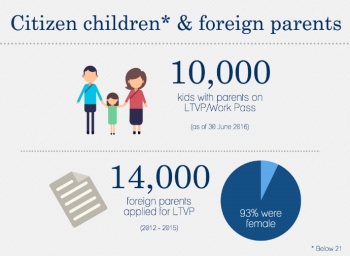
As a result, following separation, divorce or widowhood, the right of foreign wives to remain is endangered. This can be highly disruptive to women who have invested years in building a life in Singapore. In particular, mothers may face the risk of separation from their citizen children (or children may have to emigrate). MSF states it will “generally facilitate their continued stay in Singapore through a renewable LTVP” to “enable them to care for and raise their Singaporean children here”. But how can the LTVP (with its shorter terms and the necessity of regular renewal) provide enough certainty when the parent-child relationship is at stake? Which parents do not have their stay “generally [facilitated]” and why? When the children reach maturity, will the parent be forced to leave after years of providing care?
Newsletter
Get updates straight to your inbox
5. Ease housing access with clear, timed routes to PR (recommendation 4); allow citizens married to LTVP+ holders to qualify for public rental under the Family Scheme. Men married to non-PR wives can purchase HDB flats, but they are treated as singles for the purposes of housing grants, and foreign wives cannot be co-owners. Offering foreign wives a clear, timed route to PR will ease their housing access in the long term and allow their family lives to proceed on a stable footing. It will also prevent divorced mothers and bereaved wives from having to leave their homes because they are ineligible to own or inherit them.
Citizen-foreigner couples cannot rent from HDB: they are pushed to the costly open market. This reduces access to housing, as illustrated when a pregnant woman had to live on a lorry. Policies should open public rental housing to lower-income citizens married to foreigners, instead of penalising them for their low incomes three times over (denying the wife PR status which would make housing more available, depriving the families of a second income which would make housing more affordable, and forcing them onto the open market).