
Japan’s casinos should not follow S’pore’s non-transparency?

While Japan looks to Singapore for inspiration, Singapore is set to face competition as Japan legalises casinos
By: Leong Sze Hian
I refer to the article “Competition for Singapore as Japan legalises casinos” (Straits Times, Dec 17).
“After much political wrangling, the world’s third-largest economy passed a law in the wee hours of yesterday morning to allow casinos in the country, a move that Prime Minister Shinzo Abe hopes will give a fillip to the country’s stagnating economy.
Japan has looked to Singapore for inspiration. Mr Abe, who in 2014 visited Marina Bay Sands and Resorts World Sentosa in Singapore, told the Diet during the debate: “It’s not like whole cities will be taken over by casinos. These facilities will attract investment and do much to help create jobs.”
But this casino legislation has not come easy. The ruling party withstood no-confidence motions tabled by the opposition, among other delay tactics, to pass the vote on the final day of this year’s Diet session. A similarly worded Bill had been abandoned in 2013 after it was submitted to the Diet, while the debate was delayed during a second submission last year.”
Seminar in 2010 on casinos in Japan
In 2010, I was invited by the Private Public Association of Japan (PPA) to conduct a seminar in Tokyo on the economic benefits and social safeguards for casinos, as there was a lobby then to change the law in Japan to allow casinos.
The audience consisted mainly of parliamentarians and the media.
Bankruptcy increased “in every country after a casino has opened”?
In this connection, I was quoted in the article “New bankruptcy cases hit four-year high” (Straits Times, Feb 17, 2014) – “He said that when he was invited to Tokyo in 2010 to speak on casinos, he did some research and found that bankruptcy cases crept up “in every country after a casino has opened””.
44% against vs 12% for
“Public disquiet is also strong, with a poll by national broadcaster NHK earlier this week showing that 44 per cent of respondents opposed casinos, with only 12 per cent in favour and the rest unsure.”
Learning from Singapore?
As to “On this front, Japan will likely take a leaf from Singapore’s book by having Japanese nationals pay a levy for entry into the casinos, as well as by establishing exclusion programmes and problem gambling counselling, among other things, reports said.
Mr Jonathan Galaviz, a chief strategist of Las Vegas-based gaming consultancy Global Market Advisors, said Japan should consider “redirecting a good portion of gaming taxes to responsible-gaming social safeguards”.
Don’t follow S’pore’s non-transparency?
He cited Singapore as a model that “creates a balance between commerce and social needs”” – whilst I am happy that the casino legislation is now finally passed (after six years) – I would like to highlight that the Japanese should not follow Singapore’s arguably, lacking in transparency in the statistics on casinos over the last six years or so.
For example, in the Government’s review on the two integrated resorts in 2012 – a total of 273,693 local gamblers visiting the two casinos in 2011.
How much did S’poreans lose?
But, what may perhaps be a more important statistic to know is how much of the two integrated resorts’ combined annual gaming revenue of $5.7 billion and pre-tax profits of $3.6 billion then, were derived from the gambling losses of locals, rather than foreigners?
Another example of the lacking in transparency on the statistics on casinos is that in the article “Fewer locals visit the casinos; only 7.7 per cent made more than one visit in past 3 years” (Straits Times, Sep 26, 2013) said that “only 7.7 per cent of locals here made more than one visit to the two casinos here in the past three years, said the Casino Regulatory Authority (CRA) on Wednesday which was made public for the first time in CRA’s latest annual report“.
No breakdown on number times locals visited casino
CRA however did not give a further breakdown on the number of times this group of locals made to the casinos and said that the vast majority of the remaining 92.3 per cent did not visit the casinos at all.
The article further said that locals had made a daily average of 17,000 visits last year, down from 20,000 visits when the casinos first opened in 2010 which CRA attributed the drop in the number of casino visits to the effectiveness of its safeguards in deterring vulnerable individuals from problem gambling.
Only 1 page of narrative statistics?
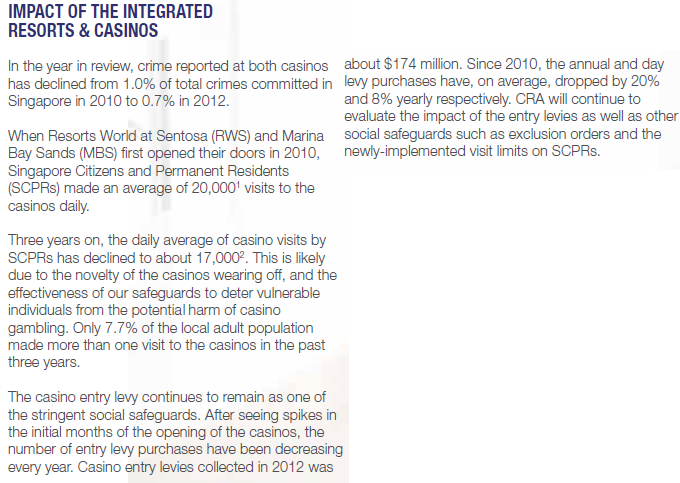
I believe the last time that questions were asked in Parliament, we never got a straight answer – and now, the CRA’s annual report which has 60 pages only contains one page of narrative on casino statistics (that I could find) – which is reproduced below.
6.2 million visits a year?
17,000 average daily casino visits by locals multiplied by 365 days is about 6.2 million visits in a year.
Isn’t this an alarming figure?
Since this was described as better than the 20,000 daily visits previously, does it mean that we had about a whopping 7.3 million visits in the previous year?
20 million local visits?
Does it mean that the first three years of the casinos attracted about 20 million local visits?
Since the 7.7 per cent figure estimated above is for those who visited more than once, what is the statistic for those who visited just once only? Why only reveal piecemeal statistics?
No breakdown of statistics?
Why is there no breakdown of the statistics (which the journalist of the subject news report also asked) into different segments such as,
- How many annual levies, daily levies;
- How many visited 1, 2, 5, 10, 20 or more times;
- How many local and foreigners’ exclusion orders
- The numbers of those automatically excluded by virtue of their situation (e.g. bankrupts, certain civil service occupations, etc),
- How many called the hotline to seek help, report concerns or assistance enquiries, etc?
Annual levies – hardcore gamblers?
With $174 million levies in a year – does it mean that there may be quite a lot of locals on annual levies who make a lot of visits who might possibly be hardcore gamblers?
In this connection, even if we assume that all were daily levies – $174 million works out to only 1.74 million visits against the estimated six million visits in a year.
“Responsible gambling” measures cause visits’ decline?
Instead of just attributing the decline in visits to “responsible gambling” measures, perhaps the other obvious possible reason which was not mentioned, may be that some may have lost so much that they don’t have much money left to go to the casinos anymore.
150,000 visit the casinos?
As I understand that the working local population age 21 and above, was then about two million – does 7.7 per cent mean that about 154,000 visited the casinos more than once?
150,000 families affected by casino gambling?
As I understand that there were then about one million local families in Singapore – does it mean that as much as 15 per cent of families may be affected by having a family member who gambles? And we are not even counting those who visited the casino just once, because we don’t know how many there were?
So how many people exactly are affected by gambling?
If we assume that four family and extended family members are generally affected – the number of affected persons may be around 600,000.
But let’s not forget that other extended families and family members, such as parents, siblings, in-laws, etc, may also be affected. So, the number of families and persons affected by gambling may be much higher.
Yet another example of the lacking in transparency on the statistics on casinos is according to the Singapore Totalisator Board’s annual report in 2013 – the “Casino entry levy of the Singapore Totalisator Board” was $416 million for the two years from 1 April 2010 to 31 March 2012.
Locals visited 4.16 m times?
Based on the per entry levy of $100 and assuming those who paid the annual entry levy of $2,000 go in for at least 20 times in a year, does it mean that locals visited the two casinos for about 4.16 million times in the two years?
Newsletter
Get updates straight to your inbox
Is this number of visits a lot?
Parliamentary reply that beats around the bush?
I understand that previous questions in Parliament on the casino statistics were not able to get a straight reply. If the above figure is correct, then we may have “accidentally” discovered the statistics that even questions in Parliament weren’t able to get. (“Parliament: Replies that never answer the question? (Act 3)“, Nov 17, 2012)
Singaporeans accounted for 25 to 30 per cent of all casino visits?
In this regard, the Straits Times article “So, what’s the true cost of casinos?” (Nov 17, 2012) said “Yesterday, the House heard that Singaporeans account for 25 to 30 per cent of all casino visits.
MPs were also assured that fewer Singaporeans were visiting the casinos, as reflected in the drop in total amount of entry levies collected. But it was not clear how many were paying the $100 daily levy and how many were opting for the $2,000 annual levy”.
I find the above may be quite strange, because if the number of Singaporeans visiting the casinos has dropped, why not just give us a straight-forward answer by giving the statistics?
Since we can say that “Singaporeans account for 25 to 30 per cent of all casino visits”, it means that we also have the statistics as to whether the number has been increasing or dropping.
So, why go a round-about way of saying that “MPs were also assured that fewer Singaporeans were visiting the casinos, as reflected in the drop in total amount of entry levies collected”?
A drop in the number of Singaporeans?
A drop in total levies may not necessarily mean a drop in the number of Singaporeans visiting the casinos, because it may mean that more people have converted to the annual levy, or more people may be visiting but each of them for a lesser number of times for the daily levy.
How many daily, annual levies?
The above may be reinforced by “But he (Minister) did not give a breakdown of how much came from the $100 daily levy and how much was from the $2,000 annual levy (“Close watch on casino gambling”, Straits Times, Nov 17, 2012).
Why not just give the breakdown so that we can see whether the the number of annual levies has increased?
Casinos will affect pachinko?
With regard to “This is especially crucial, given concerns over Japan’s gambling addiction problem and potential money laundering by yakuza crime syndicates.
Japan has more than 12,000 pachinko parlours worth an estimated US$27 billion yearly – the pinball-like slot machine game operates in a legal grey area, as prizes won are redeemed for cash at another place” – I actually ended my presentation in Tokyo in 2010 with the words – “I think the people who may lose out when there are casinos may be the pachinko operators”.