
Copyfight! What happens when copyright meets official secrets?


By: Akikonomu
In his judgement, the honorable Tay Yong Kwan appears to have made a Solomonic decision: the Attorney-General gets his Official Secrets Act to apply to the interview and transcripts, and the Estate of the late Mr Lee gets its full copyright to the same interview and transcripts. That is to say, the Estate has "full copyright and literary rights", only to the extent of checking that the Government complies with the Interview Agreement.
[caption id="attachment_57316" align="aligncenter" width="400"]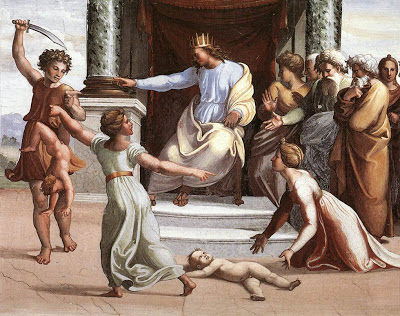 Rafael's Judgment of Solomon[/caption]
In practice, the reality of the National Archives
These materials will be part of the national archival collections and may be referred to by researchers, civil servants, teachers, students, broadcasters, and members of the public
-- announcement of the Oral History Programme by Mr Chai Chong Yii, on 6 March 1981
Yet in our previous post, we argued that this judgment seems to disregard the publicly available and legally backed operating guidelines and established practices of the National Archives regarding interviews with government officials on politically sensitive matters, to arrive at a decision that would not have made sense to the Archives, or any reputable archival institution.
From an archival perspective, insofar as the Official Secrets Act exists, the National Archives
- is legally empowered to decide how to classify and restrict access of the interviews it creates with its interviewees;
- is legally empowered and has established the practice of providing interviewees with their copy of the recording and allowing them to create their own transcripts;
- is legally empowered and has established the practice of releasing similar interviews with former government officials to the public for research and general edification; and
- did so exercise its power in its Interview Agreement, as signed between the late Mr Lee, the Archives director, and the Attorney-General.
From first principles, identifying copyright confusion
Today, we argue further that like Solomon's baby, it is unprecedented to assert the following points:
- Both the Official Secrets Act and all copyright and literary rights apply to the same work at the same time; and
- "All copyright and literary rights" have different meanings and restrictions at different times, depending on when Mr Lee was alive, when these rights have transferred to his Estate, when it will transferred to the Government in 2020, and when and whether it is finally transferred to the Archives.
This is important as Singapore is a full signatory to the Berne Convention, and the honorable Tay Yong Kwan's precedent-making judgment on this unique case will be analysed and discussed by IP scholars everywhere.
These first principles are what we at Illusio jokingly call the Laws of Copyright Conservation
- Whenever a work is created, copyright comes into existence to protect its creator(s)
- Copyright may be divested, transferred, sub-divided, or sold
- But copyright can never be destroyed (unless its statute of limitations has passed), or additionally created
- That is to say, copyright is inalienable and unwaivable
From these first principles, the honorable Tay Yong Kwan's judgment raise several areas that require clarification from a copyright perspective:
How is it that the practical "all copyright and literary rights" of the late Mr Lee over his interview and transcripts is acknowledged, while upon his death, these rights are transferred in whole to his Estate, which the honorable judge waives and alienates from the Estate, to the extent of only having the power to check that the Government comply with the Interview Agreement?
Can the severely restricted "all copyright and literary rights" currently invested in the Estate suddenly inflate itself to the full meaning of "full copyright and literary rights" upon transfer to the Government in 2020, five years after Mr Lee's death?
We at Illusio believe that applying the Official Secrets Act to the interview recording and transcripts is a clumsy legal device by the Attorney-General to circumvent the standard application of copyright law.
Very simply put: either the work is created by the Government and hence may be subject to the Official Secrets Act, or the work is created by Mr Lee and is therefore protected by copyright. There are no two ways about it.
From first principles, clarifying copyright confusion
Whosoever creates a work has rights over it
From an IP perspective, the Official Secrets Act can be argued as a special subset of copyright law, where the creator is the Government or a government official and the content of the work is politically sensitive, and the readership has been circumscribed.
While the archival perspective argues on the basis that since the interviews were created for the public, the Official Secrets Act should not apply and were not meant to apply, an IP perspective will simply ask: Who was the creator of the recording and transcripts?
Newsletter
Get updates straight to your inbox
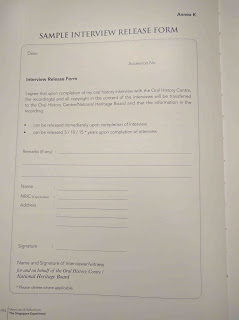
Here's the templated interview agreement of the National Archives, upon which variations were made in the Interview Agreement between Mr Lee, the Archives director, and the Attorney-General.
From first principles, the legal creators of any recording made by the National Archives are the interviewer and the interviewee. The interviewer is acknowledged as the "co-creator of historical records" (p. 96 of the Handbook) but practically speaking, all interviewers have already signed a separate agreement with the Archives to turn over their part of the copyright to the institution. That leaves the interviewee's share of the copyrights, which are essentially signed over to the Archives in the template agreement.
Reading the actual Interview Agreement, it can be argued that it is the Archives has either turned over its share of the copyright to Mr Lee or acknowledged that he is the sole creator, from the standard formulation of "all copyright and literary rights".
If we treat Mr Lee as the acknowledged legal sole creator and therefore copyright holder of the recordings, then the Official Secrets Act does not apply. If the Official Secrets Act even applied, it is clear that the Archives made a decision to declassify the recording and transcripts and then transferred its copyright entirely to Mr Lee - something it was legally entitled to do under its legal charter.
In a strange way, both copyrights and archival perspectives would end up make the same argument that both the Estate and the Attorney-General did not put forward to the Court.
--
Republished with permission from the blog 'Akikonomu'.